
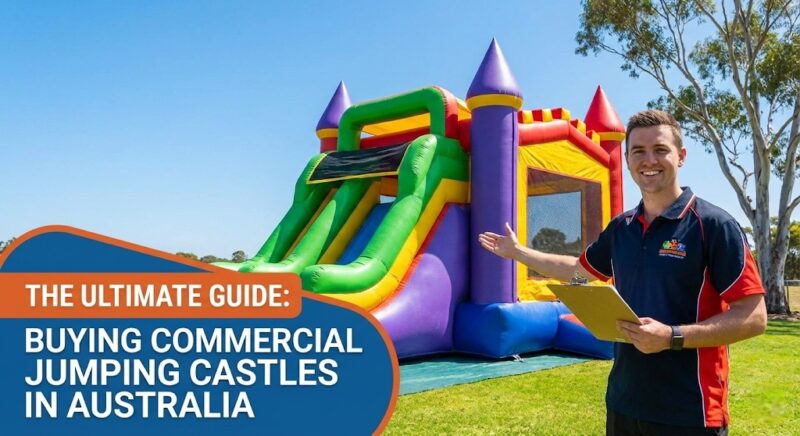
The Business Opportunity & Understanding Quality
If you have been watching the Australian events industry lately, you will have noticed one undeniable trend: Inflatables are booming. From backyard birthday bashes in the suburbs of Sydney to large-scale school fetes in regional Victoria, the demand for high-quality, safe, and exciting jumping castles has never been higher.
For entrepreneurs and hire business owners, this represents a golden opportunity. But the difference between a profitable, long-term business and a costly failure often comes down to one single decision: The quality of the castle you buy.
In this comprehensive guide, we are going to strip away the marketing fluff and look at the hard facts of buying commercial jumping castles in Australia. We will cover the Return on Investment (ROI), the critical differences between “toy” and “commercial” grades, and exactly what you need to look for to ensure your assets survive the harsh Australian climate.
The Numbers: Why Invest in Commercial Inflatables?
Before we talk about PVC and stitching, we need to talk about profit. Why are so many Australians starting inflatable hire businesses?
The answer lies in the Return on Investment (ROI). Unlike other businesses that require expensive shopfronts or perishable stock, a jumping castle is a “durable asset” that generates cash flow for years.
The “10-Hire Rule”
Let’s look at the current market rates in Australia for 2024/25.
- Average Commercial Castle Cost: $2,500 – $4,500 (depending on size/combo features).
- Average Daily Hire Rate: $250 – $450 per day (Saturday/Sunday).
If you purchase a high-quality combo castle for $3,500 and hire it out at a conservative $300 per booking, you only need 12 bookings to pay off the asset entirely. Everything after that is profit (minus insurance and minor maintenance).
Most successful hire companies in Australia see their assets fully paid off within the first 3 months of operation. A quality commercial unit, maintained well, can last for 5–7 years. That is potentially hundreds of pure-profit bookings from a single purchase.
Pro Tip: Don’t just look at the purchase price. A cheap $1,500 imported castle that tears after 5 hires effectively costs you $300 per hire. A $3,500 professional castle that lasts 300 hires costs you $11 per hire. Buy cheap, buy twice.
The “Toy” vs. “Commercial” Trap
This is the most common mistake new buyers make. You jump on eBay or a general marketplace and see a jumping castle for $800. It looks the same in the photos as the $3,000 one. Why the price difference?
The difference is Commercial Grade versus Domestic (Toy) Grade.
Domestic Castles (The “Backyard Toy”)
These are sold in department stores and general online marketplaces.
- Material: Usually Woven Nylon or Polyester (Oxford Cloth). This is the same material used for tents or cheap backpacks.
- Construction: Sewn with single stitching.
- Durability: Designed for 2–3 toddlers max. If an adult steps on it, it will likely tear.
- Life Expectancy: 30–50 hours of use.
- Legal Status: Cannot be hired out commercially. They do not meet Australian Standards for public use.
Commercial Castles ( The “Money Makers”)
These are what you need for a business.
- Material: Heavy Duty PVC Vinyl (specifically 0.55mm / 650gsm or higher).
- Construction: Welded seams or quadruple stitching in high-stress areas.
- Durability: Can handle adults, teenagers, and constant jumping for 8 hours straight.
- Life Expectancy: 5+ years of commercial use.
- Legal Status: Compliant with AS 3533.4.1 (we will cover this in Part 2), allowing you to legally hire them out for public events.
- Material Science: Decoding the “GSM”
When you are browsing Commercial Jumping Castles for Sale, you will see a lot of technical terms thrown around. The most important one is GSM (Grams per Square Metre).
In Australia, the gold standard for commercial inflatables is 650gsm (approx. 18oz) PVC.
Why PVC?
Polyvinyl Chloride (PVC) is not fabric; it is a robust, flexible plastic sheeting reinforced with a mesh interior.
- Tear Resistance: You cannot tear 650gsm PVC with your bare hands. It requires significant force or a sharp blade to penetrate.
- UV Stability: This is critical for Australia. Our sun is harsh. Inferior materials (like Nylon) will become brittle and crack after just one summer of UV exposure. High-quality commercial PVC is treated with UV inhibitors to stay flexible for years.
- Mould Resistance: Commercial PVC is non-porous. If it rains (and it will), you can wipe it dry. Nylon absorbs water, leading to the dreaded “black mould” smell that ruins rental businesses.
The “Touch Test”
If you are physically inspecting a castle, pinch the material.
- Cheap: Feels like a windbreaker jacket (thin, crinkly).
- Quality: Feels like a truck tarpaulin or a rigid pool liner (thick, heavy, slightly rubbery).
Warning: Be wary of sellers advertising “Commercial Style” or “Semi-Commercial”. These are often marketing buzzwords for Nylon castles with slightly thicker stitching. If it doesn’t explicitly state “100% PVC construction”, walk away.
The Anatomy of a Long-Lasting Castle
It’s not just about the skin; it’s about the skeleton. A jumping castle is pressurized air fighting to escape. Every time a child jumps, massive pressure spikes hit the seams.
Here is what superior manufacturing looks like:
Reinforced Stress Points
The areas where the floor meets the walls, and where the “baffles” (the internal pillars that give the castle its shape) connect, take the most punishment.
- Look for: Extra strips of PVC welded or sewn over these joints. This is called “strapping” or “reinforcement strips”. It distributes the load so the needle holes don’t stretch open.
Baffles and Chambers
Inside the mattress bed, there are hundreds of vertical strips of material (baffles).
- Cheap Castles: Use fabric baffles. If one tears, the floor bubbles up like a hernia, and the castle is ruined.
- Quality Castles: Use the same high-grade PVC for the internal baffles as the outside. This ensures the floor remains flat and firm, giving that satisfying “bounce” rather than a sinking feeling.
D-Rings and Anchor Points
In Part 2, we will discuss safety, but for durability, look at the anchor points (the metal rings you tie ropes to).
- They should be stainless steel.
- They should be attached to a heavy-duty triangular patch of PVC, not just sewn directly into the seam. If a sudden wind gust hits, a weak anchor point will rip right out of the castle wall. A proper anchor patch spreads that tension across a larger area.
Navigating Australian Standards & Safety Compliance
If “ROI” is the engine of your rental business, Safety is the brakes. In Australia, we have some of the strictest safety regulations in the world for land-borne inflatable amusement devices. This is not red tape designed to annoy you; it is a vital framework designed to keep children safe and keep business owners out of court.
For a new buyer, the phrase “Australian Standards Compliant” is often thrown around loosely. In this section, we will decode exactly what AS 3533.4.1 means, why your insurance depends on it, and how to spot a non-compliant “death trap” before you spend a cent.
The Bible of the Industry: AS 3533.4.1
In Australia, commercial jumping castles fall under the standard AS 3533.4.1 – Amusement Rides and Devices (Specific Requirements: Land-borne Inflatable Devices).
Unlike buying a toaster or a TV, you cannot just assume a product is legal because it is for sale. Many overseas manufacturers (and even some dodgy local dropshippers) sell units that meet American or European standards but fail the stricter Australian requirements.
Why does this matter?
If you buy a non-compliant castle:
- You cannot get Public Liability Insurance. No insurer in Australia will touch a device that doesn’t meet the standard.
- You are personally liable. If an accident occurs, you could face massive fines from WorkSafe (or SafeWork depending on your state) and potential criminal negligence charges.
- Venues will ban you. Council parks, schools, and corporate venues will ask for your compliance papers. No papers? No booking.
When you are shopping for Commercial Jumping Castles, the first question you must ask is: “Does this unit comply specifically with AS 3533.4.1-2005 (and its 2018 amendments)?”
Visual Safety Checks: What to Look For
You don’t need to be an engineer to spot a dangerous castle. If you are inspecting a unit or looking at photos, check these three “Red Flag” areas. These are the most common reasons castles fail Australian audits.
The “Finger Test” (Mesh Netting)
Most jumping castles have walls made of netting to allow parents to supervise.
- The Rule: The mesh must be small enough that a child cannot fit their fingers through and climb it like a ladder, but strong enough to contain a falling body.
- The Check: If the netting has large holes (like a soccer net), it is illegal. It must be a tight, heavy-duty weave that prevents “finger entrapment.”
Wall Heights & Containment
The height of the walls depends on the height of the user, but general commercial rules are strict.
- The Rule: The walls must be high enough to prevent a user from bouncing out.
- The Check: Look at the top of the slide or the bouncing area. Is the wall significantly higher than the platform? Cheap imports often have “low containment” walls to save on material costs. In Australia, these are huge liability risks.
The Entrance Step (The Fall-Out Zone)
This is where most minor injuries happen.
- The Rule: There must be a safety mat and a ramp/step that extends far enough to catch a child who stumbles out.
- The Check: The step should not be a steep vertical drop. It should be a robust, inflated ramp that covers the full width of the entrance.
The Paperwork: Your “Passport” to Profit
A compliant jumping castle is not just PVC and air; it is also a stack of documents. When you buy a commercial inflatable from a reputable Australian supplier, it should come with a specific set of papers.
Think of these like the “Rego” papers for a car. Without them, you can’t drive.
1. Design Registration Number
For larger devices, the design itself must be registered with a government WorkSafe authority. This confirms that an engineer has reviewed the blueprints and calculated the wind ratings, anchor forces, and structural integrity.
- Note: Not all small castles require individual design registration in every state, but the design must still meet the engineering standard.
2. The Logbook
Every commercial castle must have a Logbook. This is a requirement under AS 3533.4.1.
- What it tracks: Every time you set the castle up, you record the location, the ground conditions, and a quick safety check.
- Why you need it: If an inspector walks onto your site, the Logbook is the first thing they ask for. A supplier that sells you a castle without a Logbook template is setting you up to fail.
3. Annual Inspection Certificate
Once you own the castle, it must be inspected annually by a “Competent Person” (usually a qualified inspector).
- Buying New: A brand new unit from a trusted supplier usually comes with its initial “Commissioning Certificate” or proof of compliance, valid for the first 12 months.
- Buying Used: Never buy a second-hand castle without a current annual inspection certificate. If it doesn’t have one, assume it is broken or illegal until proven otherwise.
The Risk of “Grey Imports”
In the age of Alibaba and Temu, it is tempting to try and cut out the middleman by importing directly from overseas factories. This is the biggest financial risk a new business owner can take.
The “Lost in Translation” Problem
Overseas factories produce thousands of units for the US and European markets. They often do not understand the nuance of Australian Standards.
- They might use Lead-based vinyl (illegal in Australia).
- They might use Non-Fire-Retardant materials.
- They might use Weak Anchor Points that are rated for calm weather, not Australian wind gusts.
If you import a castle yourself, YOU become the manufacturer in the eyes of the law.
- You are responsible for paying an Australian engineer to test and certify the design ($1,000+).
- If the PVC contains lead, you must destroy the unit.
- If the anchors fail, you are solely liable.
By purchasing from an established Australian supplier, you are shifting that liability. The supplier has already done the engineering, paid for the testing, and guaranteed that the unit meets AS 3533.4.1. You are paying for peace of mind and immediate insurability.
Maintenance, Storage & The Secrets of Longevity
Congratulations. You now understand the financial potential of commercial inflatables, and you know how to navigate the strict landscape of Australian safety standards. You are ready to buy.
But once that delivery truck arrives and drops off your 150kg bundle of PVC, the real work begins.
The difference between a jumping castle that lasts 8 years and one that rots in 18 months comes down to one thing: Maintenance. In this final guide, we will share the operational secrets that successful hire companies use to keep their assets looking brand new, booking after booking.
Public Enemy No. 1: The “Wet Pack”
If there is one rule you must tattoo onto your brain, it is this: NEVER store a jumping castle wet.
Australia’s climate is tricky. You might have a scorching 35-degree day in Western Sydney, followed by a sudden afternoon thunderstorm. If you pack up a wet castle and leave it rolled up in a dark warehouse for two weeks, you will encounter PVC Mould.
The “Black Death” of Vinyl
Mould on PVC is incredibly difficult to remove because it eats into the microscopic pores of the material.
- The Smell: It develops a musty, rotting odour that parents will hate.
- The Look: Ugly black or green spots that ruin the “premium” look of your hire.
The Solution: The “24-Hour Rule”
Sometimes, you have no choice but to pack up in the rain to get off a customer’s property. That is fine. But you must implement the 24-Hour Rule:
- If a castle is packed wet, you must unroll it, inflate it, and let it sun-dry within 24 hours.
- Towel-dry the internal seams and the velcro strips.
- Only roll it back up when it is bone dry.
The Art of the Roll: Save Your Back (and the Bag)
The most physically demanding part of this business isn’t the jumping; it’s the packing up. A commercial combo castle can weigh between 80kg and 160kg. If you don’t roll it correctly, it won’t fit back in the bag, and you will hurt your back trying to lift it.
The “Walk-Out” Technique
- Disconnect the Blower: Open all zipper vents and air outlets.
- The Walk: Take off your shoes and walk over the deflated castle, starting from the front and moving toward the air outlets at the back. You are pushing the trapped air out.
- The Fold: Fold the castle into thirds (like a business letter). Walk it flat again.
- The Roll: Roll it tight, like a sleeping bag. One person rolls while the other walks on the roll to keep it compressed.
Pro Tip: Invest in a high-quality Sack Truck (Hand Trolley) with large pneumatic tyres. Never drag the vinyl bag across concrete driveways or bitumen roads; friction will eventually wear holes in the bag and damage the castle inside.
Essential Accessories: What Else Do You Need?
Buying the PVC unit is just the start. To comply with AS 3533.4.1 and run a smooth operation, you need the right toolkit.
1. Ground Sheets (Tarps)
Never set a castle directly on grass, dirt, or concrete.
- A heavy-duty tarp protects the underside of your castle from sharp sticks, rocks, and abrasive concrete.
- It keeps the castle clean, meaning less washing for you later.
2. Heavy Duty Anchor Pegs
Forget those little wire pegs you use for camping tents. They are illegal for jumping castles.
- Australian Standards require anchors to withstand significant wind loading.
- You need commercial steel stakes (usually 380mm long and 16mm thick) for every single anchor point on the castle.
3. Sandbags (For Hard Surfaces)
You cannot use pegs on an indoor basketball court or a concrete driveway.
- You must use heavy sandbags.
- Crucial: A 5kg bag of potting mix is not enough. You typically need 20kg–25kg of weight per anchor point (check your engineer’s report for the exact weight rating).
4. The Blower (The Heartbeat)
Most commercial castles sold in Australia require a 1.5HP (1100W) or 2HP (1500W) blower.
- Ensure your blower has an Australian plug and is electrically tested and tagged.
- Look for “gibbons” style fans or reputable commercial blowers with an IP rating (weather resistance) of at least IP24.
Cleaning & Repairs: The DIY approach
You don’t need to be a chemist to clean a jumping castle. In fact, harsh chemicals are dangerous.
- Avoid: Bleach, Chlorine, or abrasive scourers. These can strip the UV coating off the PVC, making it fade and crack in the sun.
- Use: Warm water mixed with a mild dishwashing detergent or a specialized “PVC Cleaner” (like 303 Aerospace Protectant for UV protection).
- The Magic Eraser: For scuff marks from kids’ shoes, a generic melamine foam sponge (“Magic Eraser”) works wonders.
Patching Holes
It happens. A kid smuggles a sharp toy inside, or you catch a snag on a fence. Don’t panic.
- Commercial castles come with a Repair Kit (swatches of matching PVC).
- Buy a tin of HH-66 Vinyl Cement. It is the industry standard glue.
- Clean the area, apply glue to the patch and the castle, wait 2 minutes for it to get tacky, and press it down. It cures stronger than the original material.
Start Strong, Grow Fast
Starting a jumping castle business in Australia is more than just buying a toy; it is entering the event industry. It offers incredible freedom, high profit margins, and the joy of being the highlight of every party.
But success favors the prepared.
By choosing Commercial Grade (650gsm PVC), strictly adhering to AS 3533.4.1 Safety Standards, and committing to a solid Maintenance Routine, you are building a business that is safe, legal, and profitable for the long haul.
Don’t gamble on cheap imports that will end up in landfill next season. Invest in quality assets that build your reputation.
National Reach, Local Convenience From Australian Inflatables to safeguard your investment
We understand that freight costs can eat into your profit margins, which is why we have established a robust logistics network to support hire businesses right across the country. To reduce shipping times and cut delivery costs, we have strategically allocated depots in major capital cities. Whether you are looking for commercial jumping castles in Sydney to service the NSW events market, or you need to stock up on jumping castles in Brisbane for the Queensland summer season, our local collection points make it easier to get your assets faster. We also service Melbourne, Perth, and Adelaide, ensuring that no matter where your business operates, you have a reliable supply chain supporting your growth.
Ready to start your journey? Browse our range of fully compliant, heavy-duty Adult Themed Commercial Jumping Castles and build the fleet your business deserves.

