
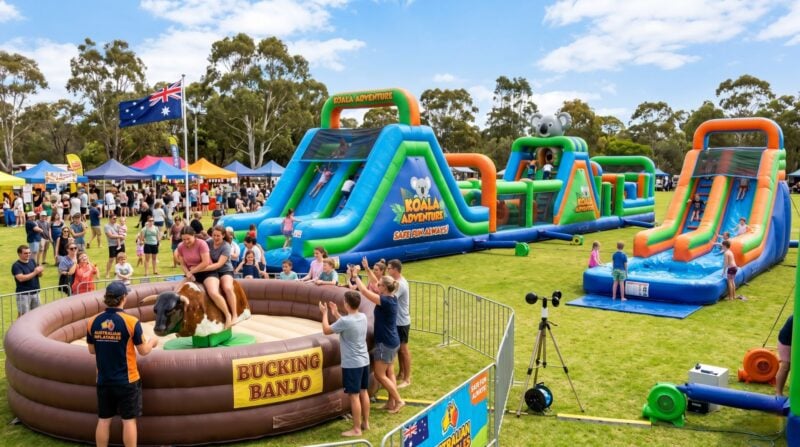
Introduction to the Evolving Amusement Rental Landscape
The commercial amusement and event hire industry in Australia has undergone a profound structural and economic transformation over the past decade. Historically dominated by conventional children’s jumping castles and rudimentary inflatable slides, the market has rapidly matured to encompass highly interactive, multi-demographic entertainment solutions. Central to this evolution is the rising prominence of advanced mechanical bulls, dynamic eliminator (meltdown) games, and modular adult-grade inflatable obstacle courses. This transition is not merely a shift in consumer preference but a fundamental expansion of the economic viability, capital expenditure strategies, and demographic reach of the amusement hire sector.
The integration of sophisticated mechanical systems with commercial-grade pneumatics has fundamentally altered the return on investment (ROI) profile for rental operators across the continent. As corporate entities, educational institutions, and private event organizers increasingly seek engaging, competitive socializing experiences, the demand for high-throughput, high-excitement attractions has surged. Consequently, the manufacturing and supply chain dynamics have also shifted, with a pronounced and necessary emphasis on localized production, rigorous safety compliance, and bespoke engineering tailored to withstand the notoriously harsh Australian climate.
This comprehensive report provides an exhaustive analysis of the Australian market for interactive inflatables and mechanical games. It examines macroeconomic trends, detailed product specifications, the stringent regulatory environment governing deployment, and strategic marketing methodologies. Furthermore, it highlights the critical role of domestic manufacturing specifically analyzing the operational blueprint of industry leaders such as Australian Inflatables in securing the supply chain and ensuring absolute compliance for enterprise operators.
Global Market Trajectories and the Australian Macroeconomic Context
To accurately contextualize the Australian landscape, it is imperative to assess the broader global trends driving the manufacture, procurement, and deployment of commercial inflatables. The broader event and entertainment market is currently experiencing robust capitalization, driven by rising disposable incomes, post-pandemic event resurgence, and an increasing societal emphasis on experiential recreation.
Global Amusement Market Valuations
The global bounce house and inflatable structure market is demonstrating sustained upward momentum, reflecting a global shift toward outdoor, interactive entertainment. In 2024, the global bounce house market was valued at approximately USD 4.2 billion. Reliable financial forecasts project an expansion to USD 6.2 billion by 2034, representing a Compound Annual Growth Rate (CAGR) of 4.1%. Alternative market analytics suggest an even steeper trajectory for specific segments; for instance, the broader inflatable play equipment market is expected to reach USD 6.74 billion by 2032, exhibiting a CAGR of 6.88%.
Concurrently, the specific sub-segment dedicated to commercial inflatable slides and highly interactive structures was valued at USD 1.2 billion in 2023, tracking toward USD 2.7 billion by 2032 at an accelerated CAGR of 9.1%. This accelerated growth in the interactive sub-segment highlights a critical consumer trend: simple static bouncing structures are losing market share to dynamic, multi-functional units that offer extended utility across varied rental and residential scenarios.
The Australian Domestic Entertainment Landscape
While global data encompasses diverse regulatory and climatic zones, the Australian domestic market exhibits highly specific growth catalysts. The Australian recreational goods and toys sector is supported by a pervasive outdoor culture, a high volume of community festivals, and an expanding corporate events sector. State-level data indicates significant regional concentration; for instance, New South Wales holds a dominant 29.85% revenue share in the broader toys and games market, while Queensland is forecast to grow at an impressive 5.95% CAGR.
This regional growth in physical entertainment runs parallel to massive expansions in digital entertainment. The Australian online gaming market generated a revenue of USD 2.21 billion in 2024 and is expected to reach USD 4.75 billion by 2030, representing a staggering CAGR of 13.1%. Within this digital sector, Multiplayer Online Battle Arena (MOBA) games and interactive shooters are the fastest-growing and largest revenue-generating segments, respectively. While digital gaming is distinctly separate from physical inflatables, analyzing these concurrent growth trajectories reveals a broader national sociological trend: an increasing allocation of per capita expenditure toward highly competitive, multiplayer, and immersive entertainment. The physical inflatable industry specifically Eliminator games and modular obstacle courses effectively serves as the tangible, real-world manifestation of this digital MOBA experience, capturing the adult demographic’s desire for physical competitive socializing.
The fundamental driver of the Australian inflatable market expansion is this deliberate demographic pivot from child-centric products to adult-inclusive entertainment. Traditional commercial jumping castles possess an inherent ceiling regarding revenue generation, as their utility is largely confined to juvenile birthday parties and primary school fetes. However, the introduction of mechanical integration has effectively captured the lucrative adult market. These assets are now ubiquitous at milestone birthdays, university orientation weeks, and corporate team-building retreats. By servicing a demographic with inherently higher capital allocation for events, rental operators have exponentially increased their addressable market and average booking values.
The Mechanical Bull Sector: Engineering, Operations, and Economic Blueprint
The mechanical bull remains one of the most consistently lucrative and culturally resonant assets within the Australian event hire inventory. Far removed from the rudimentary, highly dangerous hydraulic systems of the late 20th century that were often surrounded by inadequate beds of hay, contemporary multi-ride systems represent a sophisticated synthesis of variable-speed electric motors, localized pneumatic cushioning, and precision safety controls.
Technical Engineering and Spatial Logistics
Modern mechanical bulls deployed in the Australian market are engineered with a paramount focus on rider safety and variable difficulty scaling. A standard professional unit requires a minimum operational footprint to ensure absolute safety during kinetic dismounts. Operators must mandate a designated space of 6 meters in length, 6 meters in width, and a strict vertical clearance of 2.7 meters to accommodate the kinetic trajectory of thrown adult riders. The access path to the setup location must be at least one meter wide and preferably devoid of stairs, reflecting the substantial weight of the central mechanical motor.
The central kinetic unit is encircled by an inflatable safety mat or air cushion, ensuring that dismounts are entirely absorbed by pneumatic resistance rather than hard terrain. To maximize the authenticity of the experience, premium operators in Australia provide mechanical bulls clad in authentic cowhide, offering a tactile superiority over cheaper competitors who utilize synthetic carpet coverings.
The control console is the operational heart of the system. Advanced models feature highly calibrated, 10-speed manual control joysticks, automated rodeo programs for standardized competition, LED time clocks for staging competitive events, and, crucially, an Automatic Stop System (ASS). This stop system instantly cuts kinetic power to the bull the moment a rider dislodges, mitigating the risk of secondary blunt-force trauma from a rotating apparatus.
Furthermore, the mechanical base provides extraordinary versatility through interchangeable attachments. Modern multi-ride systems allow the central bull to be hot-swapped for thematic attachments depending on the event’s demographic. In the Australian market, operators frequently deploy mechanical surfboards for coastal events, mechanical footballs for grand final parties, or novelty items (such as beer bottles, cans, or specifically tailored X-rated attachments) designed explicitly for adult bucks and hens celebrations.
Geographic Hotspots and Deployment Strategies
Mechanical bull hire has become a definitive party trend across specific Australian geographic corridors, most notably within Queensland’s entertainment hubs. Operators report surging demand across Brisbane, the Gold Coast, and the wider Sunshine Coast. This region’s high density of outdoor festivals, combined with its status as a premier destination for milestone celebrations and corporate retreats, provides a fertile economic environment for mechanical asset deployment.
The appeal of the mechanical bull lies in its ability to deliver a perfect mix of physical challenge, communal laughter, and high-engagement spectator value. At corporate events, the ride serves as an unparalleled ice-breaker, encouraging friendly inter-departmental competition and giving colleagues a focal point for entertainment. Due to the physical demands of the ride, operators generally recommend a minimum rider age of 8 years, with the stipulation that the child must be capable of mounting the bull unassisted.
Financial Modeling and Return on Investment (ROI)
The economic viability of a mechanical bull operation in Australia is characterized by high initial capital expenditure (CapEx) offset by exceptional daily revenue yields and rapid capital amortization. Entering the professional market necessitates procuring a system that meets stringent commercial and regulatory standards.
The procurement of a commercial-grade mechanical bull, complete with the control console, inflatable surround, and requisite transportation infrastructure, typically requires an initial investment ranging from AUD 10,000 to over AUD 30,000, depending on the technological sophistication and origin of the unit. While this barrier to entry is significantly higher than that of standard jumping castles (which typically cost between AUD 1,700 and AUD 4,000) , the rental premiums commanded by mechanical assets are proportionally elevated.
Standard rental rates in Australian metropolitan hubs range between AUD 600 and AUD 1,000 for a typical 3-to-4-hour session. This baseline rate generally includes the provision of a trained, dedicated operator, which is a non-negotiable requirement for insurance compliance and risk management. For larger corporate functions or full-day festival deployments, booking fees routinely exceed AUD 1,500.
To illustrate the economic power of this asset, the following table models a conservative monthly financial projection for an established Australian mechanical bull hire operation, assuming mid-tier utilization:
| Financial Metric | Projected Value (AUD) | Operational Context and Variables |
|---|---|---|
| Average Revenue per Hire | $800 | Standard 4-hour deployment, including a trained operator and standard insurance. |
| Average Monthly Hires | 12 events | Assuming primarily weekend utilization (approx. 3 events per weekend). |
| Gross Monthly Revenue | $9,600 | Calculated base yield before variable overheads. |
| Monthly Operational Costs | $2,000 | Encompasses staff wages, transport fuel, insurance premiums, and routine maintenance. |
| Net Monthly Profit | $7,600 | Profit margin before taxation and long-term equipment depreciation. |
| Estimated ROI Timeline | 4 to 6 months | Based on consistent booking velocity, highly achievable during peak spring/summer seasons. |
The data indicates that, even with a highly conservative estimate of three events per week, the initial capital investment can be entirely recouped within a single fiscal year. Furthermore, operators can explore highly lucrative secondary revenue models. This includes permanent or semi-permanent installations in high-traffic commercial locations, such as shopping mall food courts, large-scale arcades, or family entertainment centers, generating passive income on a per-ride basis. Additionally, strategic partnerships with local nightclubs offering a weekly “rodeo night” on a profit-share model or a flat rental fee of AUD 500 to AUD 1,000 per night guarantees recurring revenue while simultaneously serving as a live advertisement to hundreds of potential future clients.
The Rise of Eliminator and Meltdown Inflatable Games
While mechanical bulls isolate individual participants in a solo battle against the machine, the “Eliminator” or “Meltdown” interactive game has emerged as the premier attraction for mass-participant competitive socializing. Influenced heavily by popular televised obstacle course programming such as Wipeout, It’s a Knockout, and Ninja Warrior, these units facilitate high-throughput engagement, making them highly desirable for school fetes, large corporate retreats, and community fundraisers where processing large volumes of patrons efficiently is critical.
Structural Specifications and Kinetic Dynamics
The Eliminator is a complex, interactive pneumatic arena that rigorously challenges the stamina, agility, and reaction times of up to eight simultaneous participants. The game is typically housed within a massive octagonal or circular inflatable structure, generally measuring 8 to 9 meters in diameter (approximately 30 feet by 30 feet).
Participants are positioned on eight individual inflated podiums arranged radially around a central mechanical hub. This hub operates two counter-rotating or sequentially rotating mechanical boom arms set at varying heights. As the trained operator manipulates the speed and directional rotation of these arms via a central console, participants must rapidly decide to duck beneath the high arm or jump over the low arm. Failure to execute the correct biomechanical maneuver results in the participant being safely swept off their podium onto the pneumatically cushioned floor.
The commercial viability of this asset is deeply rooted in its striking visual spectacle and the resultant spectator engagement. The visual contrast of the materials often utilizing striking neon greens against black, grey, and yellow to simulate a “toxic meltdown” theme creates a highly photogenic centerpiece that dominates any event space.
Due to the height and kinetic force of the rotating batons, operators must enforce strict physical restrictions. Generally, participants are required to be at least 1.2 meters (approximately 48 inches) tall to ensure they possess the necessary height and biomechanical leverage to successfully jump the lower arm. The maximum user capacity is strictly capped at eight individuals to prevent mid-air collisions during evasion attempts.
Logistical Deployment and International Pricing Benchmarks
Deploying an Eliminator unit requires precise logistical planning by the hire company. The primary mechanical motor that drives the massive boom arms is exceptionally dense and heavy. Consequently, hire companies must ascertain clear truck access to the exact setup location prior to the event, explicitly precluding installation in areas accessible only via narrow doorways, steep inclines, or prolonged staircases.
The setup process requires unrolling the massive inflatable base around the central motor, securely connecting the padded arms, and establishing discrete power connections. Due to the dual electrical requirements of the continuous high-output air blower for the base and the high-torque electric motor for the arms, operators typically require two separate standard power circuits to prevent electrical tripping. In the Australian market, where outdoor locations frequently lack integrated electrical infrastructure, the provision of commercial-grade generators represents a necessary logistical step and a lucrative upsell opportunity for rental operators.
Financially, Eliminator games command rental premiums commensurate with their scale and the necessity of two trained attendants. While domestic Australian pricing varies by state and operator density, international equivalents price a four-hour fully supervised rental at approximately USD 1,345, with additional hours billed at USD 225. Translated to the Australian market, operators frequently charge in excess of AUD 1,500 to AUD 2,000 per deployment, ensuring rapid capital amortization for the business while delivering unparalleled value to the event organizer.
Modular Obstacle Courses: Architectural Extensibility and Material Science
Parallel to the rise of mechanized inflatables is the proliferation of extreme, adult-grade inflatable obstacle courses. Traditional obstacle courses in the hire industry were historically linear, fixed-length units that severely constrained rental companies by dictating the requisite venue size and limiting variety. The contemporary Australian market, however, has pivoted sharply toward highly advanced modular architecture.
The Mechanism of Modularity and Waterborne Crossover
Modular inflatable obstacle courses utilize discrete, interconnected segments that allow an operator to dynamically scale the length, shape, and complexity of the course based on the client’s specific budget and the venue’s spatial constraints. This technological leap borrows heavily from innovations in commercial waterborne inflatables such as those manufactured by global leaders like Wibit Sports which utilize complex “Y-Connect” and “T-Connect” junction modules to create sprawling aquatic pathways.
Translating this to land-borne applications, manufacturers have developed secure connection systems utilizing a combination of heavy-duty marine-grade ropes, robust D-rings, and overlapping industrial Velcro flaps. This engineering minimizes internal air leakage, ensures long-term structural integrity, and creates seamless, trip-free junctions between wildly different obstacles.
The commercial advantages of modularity are profound for a hire business. An operator can purchase a base inventory of diverse modules—such as climbing walls, squeeze tunnels, base jumps, dual-lane slides, and “walls of men”—and combine them to create a continuous track extending anywhere from 10 meters up to a staggering 500 meters in length. Conversely, for smaller backyard deployments, the operator can detach a single 10-meter segment and rent it independently. This modularity allows a single capital asset investment to service multiple disparate events simultaneously, maximizing asset utilization rates.
The “Titanium Series” and High-Stress Material Engineering
Servicing the adult demographic requires significant advancements in material science to withstand the amplified kinetic forces generated by adult bodies. Standard children’s bounce houses are typically constructed from 13-15oz PVC, utilizing single-stitched seams. Subjecting these lighter materials to the weight of adults racing at full speed inevitably results in catastrophic seam delamination and fabric tearing.
In Australia, leading domestic manufacturers have engineered specific product lines designed exclusively for high-impact adult usage. The premier benchmark in this category is the “Titanium Series” a proprietary line engineered by Australian Inflatables, explicitly built for rigorous commercial environments such as football club presentation days, military-style boot camps, and massive university orientation events.
The structural integrity of the Titanium Series relies on the utilization of 100% commercial-grade 0.55mm Plato PVC (equivalent to premium 18oz vinyl). This specific gauge of polyvinyl chloride provides exceptional tensile strength, heavy-duty puncture resistance, and unmatched longevity under continuous UV exposure. Furthermore, the construction process fundamentally alters standard practices; manufacturers utilize quadruple stitching across all floor panels and high-stress anchor points, often reinforced with heat-welded seams. By reinforcing the exact junctions where kinetic impact is most concentrated, these engineered courses effectively neutralize the risk of blowout ruptures under the dynamic weight of adults.
Domestic Manufacturing Excellence: The “Australian Inflatables” Marketing Angle
A critical variable determining the long-term success of an Australian commercial amusement operator is the provenance and quality of their equipment. For decades, rental operators relied heavily on imported units predominantly from Asian mass-manufacturing hubs—to minimize upfront capital costs. While China possesses massive factories and robust supply chains that allow for cheap production , this paradigm is rapidly shifting. Australian operators are increasingly turning toward localized production, driven by the absolute necessity of regulatory compliance, immediate warranty support, and superior material quality.
Corporate Profile and Strategic Autonomy
Leading this domestic manufacturing shift is “Australian Inflatables,” a prominent corporate entity recognized as the only Australian-owned and managed commercial inflatables factory operating globally. Founded in 1998 and headquartered in Wauchope, New South Wales, the company boasts over two decades of specialized engineering experience. The business recently underwent a corporate acquisition in July 2023 and operates under the corporate umbrella of Kalisha Holdings Pty Ltd. To efficiently service the entire continent, the company maintains a secondary distribution and support hub in Boronia, Victoria, specifically targeting the southern states.
The strategic market positioning of Australian Inflatables rests entirely on bypassing third-party importers and international distributors. By executing direct factory-to-operator sales, they strip away the traditional markups associated with global distribution networks. This vertical integration allows them to offer premium, locally certified commercial equipment at highly competitive price points, directly challenging the financial appeal of cheaper, non-compliant international imports.
The Value of Bespoke Customization and Warranty Frameworks
A highly consequential benefit of engaging a domestic manufacturer is the capacity for rapid, bespoke customization (OEM/ODM manufacturing). Australian Inflatables permits commercial buyers to fundamentally alter dimensions, modify color schemes, and seamlessly integrate corporate branding and logos directly into the PVC fabric during the manufacturing process. This facility is invaluable for rental companies executing long-term leases with major corporate clients, or for franchise operators looking to establish a highly uniform, heavily branded rental fleet.
Furthermore, the warranty frameworks provided by domestic manufacturers reflect a profound confidence in their engineering and offer vital operational security to hire companies. Warranties in the inflatable sector are a crucial metric of reliability. While older directory listings suggest a baseline 3-year warranty , the current standardized commercial warranty offered by Australian Inflatables includes an ironclad 2-year “Stitch-to-Stitch” protection on the core inflatable structures, covering any failures in material integrity, alongside a 12-month manufacturer’s warranty on the high-output air blowers.
Recognizing the varying risk appetites of commercial operators, the company also offers an extended protection plan that pushes total coverage up to four years. Crucially, because support and repair coordination teams are based domestically within Australia, operators avoid the financially devastating downtime associated with shipping damaged units overseas for repair. This localized support infrastructure is governed strictly by Australian Consumer Law (ACL), ensuring operators receive rapid replacements or major fault rectifications without the prolonged disputes typical of dealing with overseas suppliers. For any hire company, marketing their reliance on Australian-made, ACL-backed equipment serves as a powerful testament to their commitment to quality and safety.
The Regulatory Landscape and Risk Management: AS 3533.4.1 Compliance
The commercial deployment of inflatable and mechanical amusement devices in Australia is absolutely not a deregulated enterprise. It is governed by one of the strictest and most comprehensive regulatory frameworks globally, designed specifically to prevent catastrophic failures resulting from severe wind uplift, electrical faults, or mechanical malfunctions. The absolute cornerstone of this regulatory environment is the Australian Standard AS 3533.4.1: Amusement rides and devices, Part 4.1: Specific requirements – Land-borne inflatable devices. (For aquatic environments, the equivalent standard is AS 3533.4.5 ).
Failure to adhere rigorously to this standard not only constitutes a severe offense under state occupational health and safety (OHS) regulations but also immediately voids the operator’s public liability insurance policies, exposing the business to infinite financial and legal liability in the event of patron injury.
Anchoring Systems, Wind Monitoring, and Anemometrics
The single most critical hazard facing inflatable operators is unpredictable wind sheer. AS 3533.4.1 dictates stringent, non-negotiable protocols for continuous anchoring. Devices must be securely tethered to the substrate at all times, including during periods when low winds are forecast or when the device is momentarily non-operational. Operators must utilize anchorage systems rated by the manufacturer for specific maximum wind velocities.
Crucially, operators cannot rely on arbitrary regional weather reports or smartphone applications. The standard requires operators to implement a localized “system of work,” which strongly mandates the continuous use of an on-site wind speed meter (anemometer). If the anemometer indicates that localized wind gusts are approaching the maximum rated safe operating speed outlined in the unit’s compliance manual, the operator is legally obligated to initiate the immediate evacuation of all patrons and execute a controlled deflation of the device. The unit may only be re-inflated once a competent, trained person assesses that the sustained wind speeds have safely receded below the maximum rating.
Electrical Safeguards and State Design Registration
The interaction between heavy-duty electrical components, localized pneumatics, and high-traffic public areas necessitates robust hazard isolation. The standard requires that all electrical blowers and mechanical motors be physically guarded and fenced off, preventing unauthorized access by curious patrons or the general public. Furthermore, electrical supplies must be routed through certified Residual Current Devices (RCDs) or isolating transformers to instantly sever the power supply in the event of a fault, effectively preventing lethal electrocution.
A highly specific and deeply legally binding requirement under Australian OHS law involves “Design Registration.” Any inflatable device that is classified as Class 2 or higher under AS 3533.1, or any device possessing a platform height of 3 meters or greater that relies on continuously blown air, must have its engineering design formally registered with state safety authorities (such as WorkSafe Victoria, SafeWork NSW, or the Department of Mines, Industry Regulation and Safety in WA). Procuring equipment from local manufacturers like Australian Inflatables ensures that these units are pre-engineered to 100% compliance out-of-the-box, with the necessary design registration paperwork, logbooks, and hazard identification risk assessments already completed on behalf of the operator.
Operational Supervision, Training, and the AALARA Framework
A pervasive misconception in the industry revolves around the specific licensing required to operate mechanical bulls or complex interactive inflatables. In Australia, there is no specific mandated “High Risk Work Licence” legally required solely for the operation of an amusement device, though such licenses are required for erecting scaffolding or operating forklifts during setup. However, the operator must be comprehensively trained and deemed competent by the deploying organization.
For mechanical bulls and Eliminator games, this training is intensive. It involves mastering the variable speed controls, dynamically adjusting the speed based on the competence and physical state of individual riders, and strictly enforcing sobriety protocols. Operators must have the unassailable authority to refuse access to any patron suspected of intoxication; if a much older patron argues with a younger operator, clear signage and company backing are essential.
Furthermore, operators of adult-focused mechanical assets require all patrons over the age of 18 to sign comprehensive “ride at your own risk” liability waivers to establish a secondary layer of legal indemnification. Beyond internal training, peak industry bodies, such as the Australian Amusement Leisure and Recreation Association (AALARA), provide elite compliance frameworks. For example, the AM-SAFE Safety Support Program audits and credentials operators, signaling to highly risk-averse corporate clients and stringent insurers that the business operates at the highest echelon of risk management and duty of care. To legally operate, businesses must maintain public liability insurance covering a minimum of AUD 10 Million. Furthermore, rigorous annual inspections must be carried out by a competent person to check anchor wear, fabric degradation, and staffing procedures.
To summarize the regulatory demands placed upon Australian operators, the following matrix outlines the core compliance domains:
| Compliance Domain | Regulatory Requirement under AS 3533.4.1 / SafeWork | Stringent Operational Protocol |
|---|---|---|
| Wind & Anchoring | Continuous securing; strict adherence to maximum wind speed limits. | Mandatory use of on-site anemometers; immediate evacuation and deflation if limits are breached. |
| Electrical Safety | Total isolation of mechanical components; robust weatherproofing. | Use of certified RCDs; physical fencing around blowers to prevent patron interference. |
| Asset Documentation | State plant design registration; continuous maintenance logbooks. | Pre-registration of platforms >3m; mandatory daily and annual competent person inspections. |
| Insurance & Liability | Minimum public liability coverage; formal assumption of risk. | Minimum AUD 10 Million public liability policy; signed adult waivers prior to mounting any mechanical asset. |
Strategic Marketing Angles for Australian Inflatable Hire Businesses
For operators within the Australian inflatable and amusement sector, the proliferation of high-yield products like mechanical bulls, Eliminator games, and Titanium obstacle courses requires a sophisticated evolution in marketing strategy. Relying solely on localized directory listings or informal social media marketing is entirely insufficient to secure high-value corporate, educational, and institutional contracts. Businesses must transition their brand positioning from being perceived as “backyard party suppliers” to professional “event entertainment engineers.”
The Corporate and Institutional Value Proposition
The highest profit margins in the Australian amusement industry exist within the corporate and higher-education sectors. Marketing an 8-player Eliminator game or a sprawling 50-meter Titanium Obstacle Course to a human resources director requires framing the asset not as a novelty toy, but as a sophisticated tool for team building, ice-breaking, and competitive socialization.
Operators should develop specific, high-ticket “Corporate Packages.” For example, combining an interactive Eliminator inflatable with a mechanical bull, and integrating auxiliary event technology such as portable outdoor LED screens. The integration of large LED screens allows the event to broadcast live feeds of the Wipeout game or the mechanical bull rides, amplifying the spectator experience, while also providing the corporate client with a medium for branded presentations.
By providing comprehensive hazard identification risk assessments, certificates of currency for a $20 Million public liability policy, and proof of AM-SAFE accredited staff directly within the marketing prospectus, operators instantly remove the friction and liability concerns that typically prevent corporate event planners from booking extreme physical amusements.
Leveraging Modularity for Lifecycle Marketing
The modular nature of modern obstacle courses offers a uniquely powerful lifecycle marketing opportunity. An operator can market a basic 15-meter configuration to a client for a primary school graduation one year. The following year, rather than the client seeking a different supplier for novelty, the operator can specifically remarket a 30-meter configuration to the exact same client by highlighting the introduction of new modules, such as a “columns race track” or “rope course”.
This modular upselling prevents product fatigue and ensures recurring revenue from a static client base. The marketing messaging should heavily focus on the “customizable footprint,” assuring event organizers that the attraction can be tailored precisely to the spatial limitations of their venue, whether it is a constrained indoor school gymnasium or a sprawling municipal football oval.
Capitalizing on the Spectator Economy and Social Proof
Interactive assets like mechanical bulls and Wipeout-style sweepers are inherently visual and highly performative. The entertainment value extends far beyond the active participant to the passive spectator, creating an arena-like atmosphere characterized by intense cheering, photography, and communal laughter.
Operators must actively leverage this “spectator economy” in their digital marketing strategies. High-definition video content demonstrating the kinetic action of the Eliminator arms or the dramatic dismounts from a mechanical bull—shot safely and showcasing the effectiveness of the pneumatic cushioning provides unparalleled social proof. User-generated content from milestone events (such as 21st birthdays or bucks parties) should be aggregated into highly targeted local advertising. This visually demonstrates the product’s capacity to serve as the absolute focal point of an event, creating memorable “did-you-see-that?!” moments that drive future bookings.
Mitigating Seasonal Revenue Fluctuations
While the Australian climate allows for longer operational seasons than Northern Hemisphere markets, the industry remains highly sensitive to seasonal dips during mid-winter. Astute marketers counter this by aggressively targeting indoor venues such as exhibition centers, indoor sports arenas, and large community halls during the cooler months. Because items like mechanical bulls and Eliminators do not inherently require anchoring into soil (they can operate safely on hardstands with appropriate friction matting, sandbag ballasts, and sufficient indoor ceiling clearance), they are uniquely positioned to sustain business cash flow year-round. Marketing collateral distributed in autumn should heavily feature imagery of these spectacular indoor deployments to subconsciously assure clients that inclement weather will not disrupt their meticulously planned events.
To further diversify, operators should look to expand their inventory with non-traditional inflatables. Action event providers successfully market interactive inflatable sports games, such as “Soccer Darts,” “Shoot the Hoops,” or “Inflatable Snowboard Rides,” to tap into specific sporting demographics during the winter football codes.
Strategic Future Outlook
The Australian market for commercial inflatables, mechanical bulls, and interactive eliminator games represents a highly dynamic, evolving, and exceptionally lucrative sector within the broader events economy. Driven by a global transition toward experiential entertainment and competitive socializing, the industry has successfully transcended its juvenile origins to capture the immensely profitable corporate, collegiate, and adult demographic.
The economic architecture of this sector is highly compelling for entrepreneurial operators. While premier assets such as the 8-player Eliminator game or commercial-grade mechanical multi-ride systems require substantial initial capital expenditure, the premium rental yields and high utilization rates facilitate a rapid return on investment, often achieving full amortization within a single peak season. However, this profitability is inextricably linked to strict adherence to rigorous engineering, material science, and safety standards. The regulatory environment in Australia, governed uncompromisingly by AS 3533.4.1, demands an unwavering commitment to operational excellence, continuous anemometric environmental monitoring, and meticulous equipment maintenance.
In this complex landscape, domestic manufacturers such as Australian Inflatables have emerged as absolutely critical partners for rental operators. By supplying precision-engineered, localized solutions such as the heavy-duty, 0.55mm PVC modular Titanium Series these manufacturers effectively eliminate the compliance ambiguities, warranty nightmares, and supply-chain fragilities associated with foreign imports. They provide the robust, ACL-backed warranty frameworks necessary for sustained, stress-free commercial operation.
Moving forward, the operators who will dominate the Australian market are those who recognize themselves not merely as equipment renters, but as professional risk managers and elite entertainment facilitators. By heavily marketing their safety compliance credentials alongside the visceral, high-adrenaline excitement of their product fleet, and by utilizing modular systems to dynamically adapt to diverse corporate and residential environments, these businesses are perfectly positioned to extract maximum yield from Australia’s ever-expanding appetite for dynamic, large-scale amusement.
Test Your Knowledge: The Australian Amusement Hire Market

