
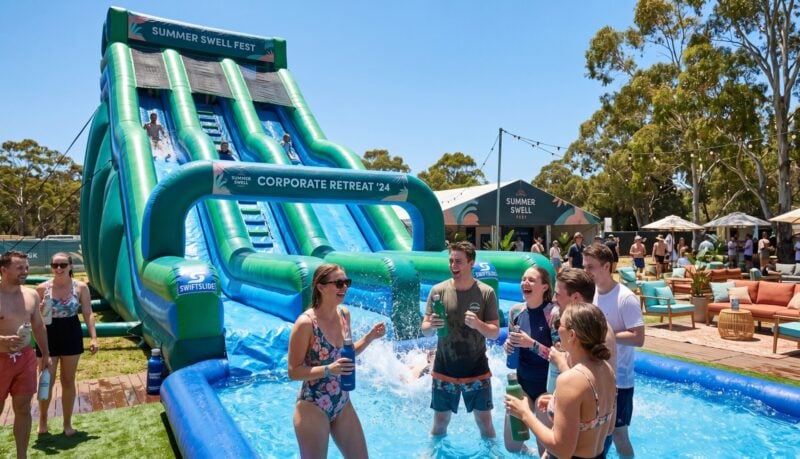
The landscape of Australian outdoor entertainment has undergone a profound structural shift over the past decade. The traditional paradigm, which historically relegated inflatable amusement devices exclusively to the realm of children’s backyard birthday parties, has been rapidly eclipsed by a maturing commercial sector catering explicitly to adults. Specially the sector of commercial inflatable water slides for adults with a financial boom. Today, massive, commercial-grade inflatable water slides function as high-yield centrepieces for corporate functions, music festivals, brand activations, and large-scale community events. Driven by a cultural appetite for experiential, high-adrenaline entertainment and facilitated by significant advancements in polymer engineering, the Australian inflatables market is experiencing robust year-on-year growth. Industry forecasts have recently valued the broader Australian inflatables market encompassing commercial water slides, jumping castles, and modular obstacle courses at nearly A$1 billion, with projected annual growth rates hovering between six and seven percent.
This comprehensive analysis examines the structural engineering, commercial viability, rigorous safety compliance frameworks, and asset management protocols required to successfully operate premium adult inflatable water slides in the demanding and varied Australian climate. The following sections dissect the economic principles driving rental returns, the intricate compliance standards mandated by Australian authorities, and the physical science underlying modern inflatable water slides manufacturing.
Demographic Shifts and the Evolution of Event Programming
The surge in demand for adult-oriented inflatable water slides is fuelled by a convergence of cultural trends and highly strategic corporate event planning. Australia’s climate, characterised by scorching summer heat and an enduring culture of outdoor entertaining, provides the ideal environmental catalyst for water-based amusements. However, the primary demographic driving the commercial sector has pivoted sharply toward Millennials and Generation Z, cohorts that consistently prioritise active, experiential entertainment over passive consumption.
Corporate Engagement and Experiential Team Building
Corporate Australia has recognised the immense psychological and social value of integrating large-scale inflatables into professional gatherings. Traditional, rigid corporate formalities and conventional team-building exercises are increasingly being replaced by dynamic, high-energy alternatives. Giant inflatable water slides, modular obstacle courses, and interactive wet challenges provide highly effective ice-breaking mechanisms that flatten corporate hierarchies and foster genuine team bonding.
Human resources departments and corporate event organisers leverage these towering structures for end-of-year celebrations, family fun days, and staff retreats because they appeal to a broad demographic, are easily orchestrated under professional supervision, and encourage shared, memorable experiences. The inherent physical comedy and exhilaration of navigating a massive slip-and-slide or a multi-lane drop slide dissolves workplace tensions, ensuring that corporate events are viewed as highly anticipated social gatherings rather than mandatory professional obligations.
Festival Activations and High-Visibility Brand Marketing
The utility of giant commercial inflatables extends far beyond private corporate hire; they have become critical infrastructure for music festivals and high-profile brand activations across the continent. As modern music festivals scale in capacity, event organisers deliberately curate alternative programming to cater to diverse audience interests, fostering unexpected discovery and deeper patron engagement.
For example, at the Beyond the Valley music festival in Victoria, which has grown to accommodate 40,000 attendees, the integration of experiential spaces demonstrates how large-scale structures are used to capture audience attention. Festival activations have evolved to include bespoke, brand-sponsored environments, such as pool houses, ice-cream shop façades hiding secret venues, and interactive harm-minimisation zones. In this highly competitive attention economy, custom-designed giant inflatables operate as undeniable, high-visibility brand beacons.
Bespoke inflatable water slides can be manufactured with specific corporate colour palettes, interchangeable Velcro banner placements, and three-dimensional logo integrations. This provides a highly photogenic aesthetic that translates seamlessly into organic social media marketing for the hosting brand. Whether it is a giant misting tunnel shaped like a beverage can, a custom replica of the Sydney Opera House transformed into a bounce environment, or an immense dual-lane water slide dominating a festival skyline, these structures generate massive organic reach as attendees capture and share their experiences digitally.
The Evolution of Scale and Technology
To meet the thrill-seeking demands of adult users, the physical scale of these inflatable devices has expanded exponentially. The market increasingly demands multi-storey structures featuring near-vertical initial drops, elongated slip-and-slide horizontal runouts, and massive splash pools. Australia is already home to several record-breaking attractions for adults, such as “The Big Wedgie,” an 18.2-metre-tall inflatable water slide that validates the adult appetite for extreme inflatable thrills. Similarly, structures like the 23-metre-long Purple Crush Dual Lane slide, which towers 8.5 metres (approximately three storeys) high, have become standard flagship offerings for metropolitan rental fleets in cities like Brisbane and Sydney.
Looking forward, the sector is moving steadily toward technological integration. Manufacturers are actively exploring the incorporation of sophisticated electronic systems into the PVC architecture. Emerging trends point toward inflatable slides embedded with LED lighting arrays for night-time festival operation, integrated digital timers that allow racing participants to clock their descent speeds, and augmented reality (AR) overlays. In these AR environments, users can interact with a smartphone application to trigger digital sounds and visual effects or collect virtual points as they navigate the physical slide, seamlessly merging digital gamification with real-world physical exertion.
| Trend Category | Current Market Manifestation | Future Technological Trajectory |
| Physical Scale | 8 to 10-metre towering multi-lane drop slides. | Structures approaching the scale of permanent water park rides. |
| Corporate Utility | Team-building, corporate family days, ice-breakers. | Fully immersive branded obstacle courses for product launches. |
| User Interaction | Physical racing on dual-lane slip-and-slides. | Integrated digital timers, LED lighting, and Augmented Reality (AR). |
| Event Integration | Core attractions at music festivals and council events. | Dedicated adult-only inflatable pop-up theme parks. |
Commercial Design and Materials Engineering
When procuring an adult inflatable water slide for commercial deployment, the distinction between standard residential-grade yard toys and professional commercial-grade assets is defined by stringent materials science and advanced construction methodologies. Operating an inflatable structure that safely accommodates adult weights and endures high-frequency usage in harsh environmental conditions requires uncompromising structural integrity.
PVC and Polymer Specifications
Commercial-grade water slides deployed in Australia are predominantly manufactured from 0.55mm (18oz) PLATO PVC Tarpaulin or heavy-duty 1000D PVC. This specific, high-density grade of polyvinyl chloride is mandatory because it is inherently waterproof, highly puncture-resistant, fire-retardant, and lead-free. Crucially, the PVC must be engineered with advanced UV stabilisers to prevent rapid molecular degradation under the intense ultraviolet radiation characteristic of the Australian sun.
The sheer density of these required materials dictates that commercial slides are massive logistical undertakings. While a standard residential bounce house might weigh a manageable 68 kg, an adult-rated commercial water slide often weighs between 150 kg and 250 kg. Extended modular obstacle courses, which frequently culminate in a water slide finish, can achieve cumulative weights exceeding 4,800 kg. This immense material density is necessary to safely support adult weight capacities. Manufacturers typically engineer commercial slides to handle continuous dynamic loads, with maximum individual user weight limits averaging 200 to 250 pounds (90 to 113 kg) per person. The total concurrent load limit for the entire structure is strictly calculated by structural engineers based on the cubic volume of the primary air chambers and the output capacity of the continuous air blowers.
Joining Methodologies: Heat Welding vs. Chemical Adhesives
Perhaps the most critical engineering divergence in the manufacturing of commercial inflatables is the method utilised to bond the PVC panels. Over the past decade, the industry gold standard for water-based inflatables has shifted decidedly away from traditional chemical adhesive gluing toward advanced hot-air welding technology.
All coated fabrics used in the construction of inflatables whether PVC, urethane, or Hypalon rely on chemical plasticisers to maintain their flexibility and resistance to UV radiation. When traditional chemical adhesives are employed to join panels, a chemical phenomenon known as “plasticiser migration” inevitably occurs over time. The plasticisers slowly leach out of the PVC coating and interact with the glue. Heat and high humidity environmental conditions endemic to Australian summers rapidly accelerate this migration process. Consequently, the adhesive interface loses its cohesive strength, dries out, and eventually fails, leading to ruptured seams and catastrophic pressure loss.
Conversely, hot air welding completely eliminates the need for an adhesive interface. This manufacturing process involves passing the overlapping layers of PVC through a specialised machine that applies precise hot air to the contact points while simultaneously applying mechanical pressure. This process alters the state of the thermoplastic polymer, melting the materials and fusing them together to create a continuous, homogenised bond. A properly executed welded lap seam is fundamentally stronger in the shear direction than the surrounding base fabric itself.
The transition to heat-welded construction yields multiple operational advantages for the rental business owner. Welded seams are entirely airtight, allowing the slide to maintain higher internal air pressures (PSI) safely, which results in a firmer, more rigid sliding surface that performs better under adult weight. Furthermore, welded seams are highly resistant to the peeling and separation caused by prolonged exposure to standing water and intense heat, dramatically extending the operational lifespan of the asset. For high-stress areas that cannot be easily welded, such as the interior baffling matrices or the primary bounce floors of integrated jumping castles, manufacturers mandate quadruple stitching using heavy-duty, rot-proof nylon threads.
| Structural Feature | Hot-Air Welding Construction | Traditional Adhesive Bonding (Gluing) |
| Bond Longevity | Indefinite; no adhesive layer to degrade. | Limited lifespan; highly prone to plasticiser migration. |
| Climate Resilience | Exceptionally resistant to UV, heat, and high humidity. | Weakens rapidly in tropical or high-heat environments. |
| Air & Pressure Retention | Completely airtight; safely tolerates higher internal PSI. | Micro-leaks frequently develop as the glue ages and crystallises. |
| Environmental Impact | Eco-friendly manufacturing; zero chemical solvents. | Releases harmful Volatile Organic Compounds (VOCs). |
| Overall Weight | Lighter profile due to the absence of heavy adhesive layers. | Heavier and bulkier seams due to adhesive buildup. |
Modular Architecture and Dual-Lane Dynamics
Modern adult water slides frequently utilise modular architectural extensions of adult inflatable water slides, to maximise participant throughput and event excitement. Dual-lane designs are particularly sought after by corporate and festival clients, as they permit competitive, side-by-side racing, easily accommodating high hourly capacities that keep queuing times to a minimum.
Massive configurations such as 23-metre modular obstacle hybrids combine near-vertical initial drops with extended horizontal slip-and-slide runouts, culminating in a deceleration splash pool. These complex units feature sophisticated internal baffling systems designed to isolate kinetic energy. This isolation ensures that the sudden impact and shifting weight of a 90 kg adult descending one lane does not cause structural deformation, loss of pressure, or destabilisation in the adjacent lane, thereby preserving the safety of concurrent users. Furthermore, modular designs allow operators to connect various obstacle components such as climbing walls, squeeze-throughs, and inflatable pop-ups—to form extensive floating or land-based tracks, offering customisable layouts tailored to specific event footprints.
Regulatory Compliance and Strict Safety Frameworks
Operating commercial inflatables in Australia is governed by a strict, uncompromising legal and regulatory matrix designed to mitigate the risk of severe injury or fatalities. Following catastrophic industry events most notably the tragic 2021 jumping castle incident in Tasmania, where anomalous extreme winds caused a fatal structural lift Australian regulatory authorities heavily revised and tightened compliance standards. Today, commercial operators must strictly adhere to AS 3533.4.1:2018 (Amusement Rides and Devices Land-borne Inflatable Devices) and the updated AS/NZS ISO 8124.1:2023 framework, which aligns structural testing with international safety benchmarks.
Structural Safety and Anchoring Dynamics
A towering 8.5-metre water slide possesses an enormous surface area, effectively acting as a massive sail when exposed to sudden gusts of wind. Consequently, AS 3533.4.1 dictates precise, non-negotiable engineering calculations for structural anchorage.
When installing an inflatable on soft surfaces such as grass or soil, operators must utilise heavy-duty steel stakes (typically measuring 600mm in length by 20mm in diameter). These must be driven deeply into the ground at a specific angle at every single tether point provided by the manufacturer.
However, when setting up on hard surfaces such as concrete car parks, school asphalt, or indoor venues where driving stakes is impossible, operators cannot rely on rudimentary sandbags. Engineering guidelines mandate immense tethering weights to counteract potential uplift forces. Depending on the cubic volume of the slide, manufacturers may require up to 230 kg of static weight per individual anchor point. For a large adult water slide featuring a dozen anchor points, the cumulative concrete ballast requirement can easily exceed 3,000 kg. Because transporting and positioning these massive concrete blocks requires significant logistical effort, professional hire companies universally enforce hard-surface anchoring fees, which typically range from $200 to $1,500 per event.
Environmental Protocols and Wind Speed Monitoring
Wind poses the single greatest operational threat to inflatable amusement devices, risking catastrophic failure or the device becoming airborne. Safe Work Australia mandates that inflatable devices must be immediately evacuated and deflated if wind gusts exceed the manufacturer’s specified safety limits, or reach an absolute maximum threshold of 40 km/h. In practical application, conservative and highly professional operators implement a broader safety buffer, halting operations and initiating controlled deflation at sustained wind speeds of 25 to 30 km/h.
To ensure precise environmental awareness, operators are required to utilise a calibrated anemometer (wind speed meter) continuously on-site. Operators must regularly record these wind readings in an operational logbook, as weather conditions can deteriorate rapidly. Furthermore, inflatables must never be operated during thunderstorms due to the severe risk of electrocution from the 240V continuous air blowers, nor should they be used in heavy rain, which destabilises the structural footprint and dangerously alters the friction coefficient of the sliding surface.
Splash Pool Physics and Deceleration Zones
The engineering of the splash pool and deceleration runout is arguably the most critical biomechanical safety feature on an adult water slide. When an adult weighing 90 kg descends a steep 10-metre flume, they generate substantial kinetic energy. This energy requires precise dissipation at the terminus of the slide to prevent the user from “bottoming out” and striking the underlying hard ground, which can lead to severe lower limb fractures or spinal injuries.
Regulatory compliance specifications dictate strict architectural parameters for these deceleration zones:
- Minimum Pool Depth: For high-speed flumes and adult-rated drop slides, the water depth in the landing pool at the end of the runway must be maintained at a minimum of 3.5 feet (approximately 1.06 metres) from the normal operating water level to the floor, ensuring sufficient buoyancy to arrest the slider’s momentum.
- Deceleration Length: The splash pool or horizontal slip-and-slide runout must feature a clear deceleration zone of no less than 20 feet (6.09 metres) from the point of exit to the opposite wall, allowing riders to come to a safe, gradual halt without encountering physical obstructions.
- Exit Vectors and Collision Avoidance: If a slide features multiple intersecting flumes, the architectural design must force exiting riders to move forward and deliberately away from the landing paths of adjacent lanes, fundamentally eliminating the risk of high-speed patron collisions.
- Impact Attenuation Mats: In addition to the hydrostatic resistance provided by the water, heavy-duty impact-absorbing mats (spanning a minimum of 6 to 8 feet wide) must be securely installed at the exit zones beneath the pool liner to cushion inevitable ground contact.
Anti-Entrapment Mechanisms and Material Toxicity
To comply fully with the AS/NZS ISO 8124.1:2023 standard which aligns jumping castle regulations with international mechanical safety benchmarks for large toys the physical topology of the slide must be meticulously vetted. The design must actively eliminate all V-shaped gaps, narrowing crevices, or completely bound openings where an adult or child’s head, neck, or limbs could become entrapped during active play. Furthermore, small mesh netting must be integrated into all elevated platforms to prevent accidental falls from height, while permitting adequate airflow and line-of-sight for supervisors.
Because dermal contact is prolonged and friction is high in wet operating conditions, all PVC fabrics and digital printing inks must be rigorously laboratory tested to ensure they are non-toxic, lead-free, and compliant with strict chemical exposure limits.
Investment Economics: Analysing the ROI for Hire Businesses
For entrepreneurs and established rental operators, the commercial inflatable water slide market offers an exceptionally rapid return on investment (ROI), provided that initial capital allocation targets premium, high-durability equipment. Understanding the unit economics of the rental fleet is essential for navigating the highly competitive event hire landscape.
Capital Expenditure and Pricing Power
The initial purchase price for a commercial-grade, dual-lane adult inflatable water slide typically ranges from $4,500 to $12,000, scaling upward based on height, extended length, and the complexity of modular obstacle integrations. While budget-conscious operators may attempt to purchase smaller, residential-grade units for under $2,000, these units lack the structural integrity for adult use and possess significantly shorter lifespans. Conversely, operators targeting the lucrative corporate event, festival, and luxury private party sectors purposefully invest in premium, high-performance slides often exceeding 20 metres in length.
This premium market positioning yields substantial pricing power. High-end commercial slides routinely command daily hire rates of between $700 and $1,500. For instance, a towering 23-metre slide operating in the Brisbane market can be leased starting at $1,450 per day. Operators generate additional ancillary revenue through necessary surcharges, including hard-surface anchoring fees ($200 to $450), petrol generator hire for sites lacking 240V power ($120 to $150 per day), and mandatory on-site supervision fees charged at an hourly rate.
Break-Even Analysis and Yield Optimization
The break-even formula for determining water slide profitability is straightforward: divide total fixed costs (the initial purchase price, annual insurance premiums, and warehousing) by the contribution margin per rental (the daily rental rate minus variable delivery, fuel, and labour costs).
Because premium inflatable units command such elevated daily rates, the break-even point is astonishingly low compared to other industrial asset classes. An operator purchasing a flagship $10,000 slide and charging an average of $1,000 per premium event can achieve full capital recovery in just 10 to 12 rentals. In the context of a prolonged Australian summer which effectively spans six months from late October through the Easter holidays a highly sought-after slide can easily be deployed two to three times per week. Consequently, seasonal gross returns of 200% to 300% on the initial asset cost are readily achievable, categorising premium commercial inflatables as one of the fastest-paying investments in the broader equipment rental industry.
| Financial Metric | Standard Residential Grade | Premium Commercial Grade |
| Initial Capital Cost | $1,800 – $4,000 | $8,000 – $15,000+ |
| Average Daily Hire Rate | $250 – $400 | $700 – $1,500 |
| Primary Target Market | Backyard birthdays | Corporate events, Festivals |
| Estimated Break-Even Point | 15 – 25 hires | 8 – 12 hires |
| Asset Lifespan (Cycles) | 100 – 200 rentals | 500+ rentals |
The Value of Equipment Leasing and Tax Optimisation
For operators unwilling or unable to commit deep upfront capital, commercial equipment leasing offers a viable alternative to direct purchasing. Properly calculating the ROI of leased assets requires accounting for the full lifecycle cost including the total sum of monthly payments, anticipated maintenance fees, and return courier charges against the preserved operational cash flow. This preserved capital can be strategically reinvested into vital business infrastructure, such as digital marketing campaigns or heavy-duty transport vehicles. Under the IFRS 16 lease accounting standard, operators must reflect these leases on their balance sheets, ensuring transparent tracking of asset profitability. Furthermore, aggressive tax strategies, such as utilising the Australian instant asset write-off (or leveraging Section 179 deductions and bonus depreciation frameworks), effectively reduce the net capital required, further accelerating the speed at which a commercial water slide pays for itself via post-tax rental income.
Risk Management: Navigating the Public Liability Insurance Landscape
The highly litigious nature of the amusement and event operations industry dictates that comprehensive insurance is an absolute, non-negotiable operational necessity from day one. The potential financial ruin resulting from a single personal injury or property damage claim on an un-insured slide far outweighs the operational costs of maintaining robust coverage.
Australian corporate law, local municipal councils, and state education departments almost universally require operators to hold Public Liability Insurance with a minimum coverage limit of $20 million before permitting the setup of inflatable devices on public property, council parks, or school grounds.
Securing appropriate insurance for inflatable water slides, however, presents unique systemic challenges. The inherent risks associated with high-speed water descents, slippery surfaces, and the dynamic momentum of adult weights result in amusement operators facing some of the highest premium brackets of any commercial trade. Standard small business liability policies frequently carry explicit exclusion clauses for inflatables of any kind, including jumping castles, ball pits, and slip-and-slides.
Consequently, operators are forced to seek coverage through specialist underwriters or niche insurance brokers capable of placing high-risk amusement profiles in surplus lines markets. While a standard low-risk tradesperson (such as a sole-trader gardener) might secure $20 million in public liability coverage for approximately $600 annually, an inflatable hire business can expect baseline premiums ranging from $1,200 to well over $5,000 annually. These premiums scale aggressively based on the size of the equipment fleet, previous claims history, and projected gross annual revenue.
To successfully negotiate coverage and mitigate these prohibitive premiums, operators must present a demonstrably rigorous risk management profile to underwriters. Insurers heavily favour operators who maintain meticulous digital logbooks of daily pre-event inspections, mandate signed participant liability waivers, employ staff formally trained in AS 3533.4.1 compliance, and execute strict, documented weather monitoring protocols.
Preventative Maintenance and Long-Term Asset Preservation
A commercial inflatable water slide is a highly intensive capital asset; the profitability of the business is directly tied to extending its operational lifespan. With proper, clinical care, a premium heat-welded commercial unit can deliver over 500 rental cycles, remaining viable for five to ten years. However, the combination of standing pool water, high UV exposure, and mechanical stress requires a meticulous approach to asset management.
Combating UV Degradation and Chemical Wear
The relentless Australian sun aggressively attacks and degrades polymer chains. Prolonged ultraviolet exposure strips the PVC of its vital chemical plasticisers, leading to aesthetic discoloration, severe material embrittlement, structural cracking, and ultimately, catastrophic seam failure.
To actively combat this degradation, professional operators routinely treat their entire fleets with advanced UV protectants, most notably the industry-standard 303 Aerospace Protectant. Originally engineered for demanding aviation and aerospace applications, this water-based, non-toxic polymer treatment acts essentially as an “SPF 40” sunscreen for PVC and vinyl surfaces. Applied every 4 to 6 weeks, it replenishes the material’s surface tension, effectively repelling dirt, hard water spots, salt, and mildew without leaving a greasy residue. Critically, operators must explicitly avoid cheap automotive vinyl sprays that contain silicone oils, waxes, or petroleum distillates. These inferior chemicals accelerate the breakdown of PVC, trap heat, and dissolve the heavy-duty nylon seam threads, ultimately causing more damage than they prevent.
The Pathology of Mould and Moisture Control
Mould and mildew are the primary destroyers of stored commercial inflatables. When a massive water slide is deflated, rolled, and packed away while even slightly damp, fungal spores proliferate exponentially within the dark, warm microclimate of the PVC folds. Mould does not merely cause aesthetic staining; the fungal mycelia penetrate the woven backing of the Oxford cloth or PVC, irreversibly rotting the structural threads of the quadruple stitching and compromising the entire unit.
To prevent this biological degradation, the industry enforces the strict “48-Hour Drying Rule”.
- Chemical Neutralisation: Immediately following an event, the slide must be thoroughly cleaned using mild, non-abrasive detergents (such as simple dish soap) to remove body oils, sunscreen, and dirt, all of which act as food sources for mould. All soap residue must be entirely rinsed away, as residual soap attracts and traps atmospheric moisture.
- Forced Evaporation: The slide is fully inflated and allowed to air-dry. Industrial box fans and high-velocity leaf blowers are strategically deployed to force air across the surface, particularly targeting deep crevices, overlapping seams, deflation zippers, and D-ring anchor pockets where water naturally pools.
- Climate Control: In highly humid coastal regions like Queensland or New South Wales, the mandatory drying process must be extended to a full 72 hours, flipping the unit halfway through to ensure both the sliding surface and the underbelly dry evenly.
Warehouse Storage Protocols and Pest Mitigation
Once the slide is verified as bone-dry, it is deflated and rolled systematically to expel internal air without unnecessarily stressing the vinyl. The unit must be secured tightly with flat nylon straps; operators must avoid using bungee cords, as they create high-pressure pinch points that permanently crease and weaken the PVC fabric.
The warehouse storage environment is of paramount importance. Facilities should maintain an ambient temperature between 10°C and 25°C. Storing units in unheated garages in freezing zones causes PVC to shatter under impact, while extreme heat accelerates plasticiser bleed. Relative humidity must be maintained strictly below 50% using commercial-grade dehumidifiers, and silica gel desiccant packs should be placed inside the folds of the stored units for added moisture absorption.
Furthermore, operators must implement aggressive rodent mitigation protocols. Folded PVC acts as an exceptional thermal insulator, making stored inflatables highly attractive nesting grounds for mice and rats during the cooler months. A single rodent breach characterised by chewed vinyl, urine staining, and embedded nesting material can result in thousands of dollars of unrepairable damage. All assets must be elevated off the concrete floor on pallets or heavy-duty shelving (maintaining a minimum 6-inch clearance) to prevent moisture wicking and to allow for visual inspection of droppings. Rodent deterrent stations are placed around the warehouse perimeter, but never directly inside the folds of the slide.
Daily Pre-Operation Checklists and Site Logistics
In addition to long-term storage protocols, front-line safety and asset protection are ensured through rigorous, documented daily inspections. Before permitting public access or connecting the water supply, operators must execute a comprehensive site checklist:
- Site Inspection and Clearance: Verifying a flat topography free of sharp ground debris or gravel. Operators must check for adequate overhead clearance (avoiding power lines and tree branches) and calculate the mandatory minimum 5-foot perimeter clearance around the entire footprint of the slide to ensure safe entry and exit.
- Flume and Pool Integrity: Inspecting the slide path and splash pool liner for abrasive wear, tears, or leaking joints. The water flow rate must be calibrated via standard 20 to 30-metre hoses to maintain optimal surface friction without overflowing the splash pool, while ensuring proper drainage protocols are in place to prevent site flooding.
- Mechanical and Electrical Safety: Testing the GFCI (Ground Fault Circuit Interrupter) outlets to prevent shock hazards in wet environments. Operators must inspect blower power cords for fraying, ensure the 240V blower intakes are completely free of blockages, and confirm that all electrical components are shielded from the water source.
- Anchor Tension and Structural Seams: Physically testing the tension on every steel tether and confirming that tie-down straps show no signs of micro-tearing. The operator must listen and feel along the heat-welded seams for any indication of abnormal pressure loss.
Thematic Trends and the Future of Inflatable Entertainment
To remain competitive and secure bookings for high-profile corporate events and summer festivals, hire companies must continuously update their fleets to reflect popular thematic trends. The aesthetic design of the water slide is often as important as its physical dimensions.
Currently, the Australian market exhibits a strong preference for immersive, highly decorated themes. Tropical and “Hawaiian Beach Bash” aesthetics featuring inflatable palm trees, bright neon colours, and integrated Tiki falls are universally popular for summer events. Conversely, for older teens and adults, adrenaline-focused themes such as “Toxic Drop” or “Nuclear Rush,” which feature hazard-yellow and black colourways with modular obstacle challenges, are highly sought after to stimulate friendly, fast-paced competition. The versatility of these commercial inflatables allows event organisers to transform an empty suburban park or corporate campus into a fully realised, themed water park within a matter of hours.
Gaining popularity Of Inflatable Water Slides For Adults In Australia
The commercial adult inflatable water slide sector in Australia has successfully and permanently transitioned from a niche party rental offering into a highly sophisticated, lucrative segment of the broader events, corporate, and hospitality industry. As corporate entities, local councils, and music festival promoters continue to leverage experiential physical activities to drive audience engagement and team building, the market demand for massive, awe-inspiring modular water structures will only intensify.
For the commercial operators provisioning this equipment, long-term success hinges on a delicate balance of aggressive capital investment and clinical risk management. Procuring heavy-duty, heat-welded commercial PVC structures guarantees that the product will survive both the extreme dynamic physical loads of adult users and the punishing UV radiation of the Australian climate. The remarkably rapid return on investment—often achieved within a single ten-hire summer season justifies the high initial capital expenditure. However, these high profit margins are quickly eroded if operators fail to strictly manage asset maintenance, execute the 48-hour mould prevention drying rule, and maintain climate-controlled equipment storage.
Above all, the modern operational landscape is defined by its rigorous adherence to safety and compliance. Strict compliance with AS 3533.4.1:2018, the mandatory utilisation of anemometers for wind monitoring, and the maintenance of substantial $20 million public liability insurance policies are the foundational, non-negotiable pillars of a sustainable business model. By marrying cutting-edge structural polymer engineering with exhaustive daily safety protocols, the Australian commercial inflatables industry is exceptionally well-positioned to continue delivering high-adrenaline, highly profitable entertainment while effectively mitigating the inherent risks of commercial amusement operation.

