
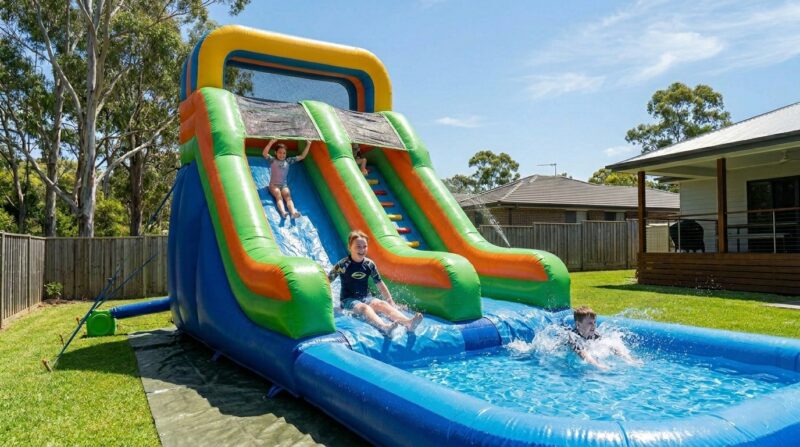
No outdoor celebration in Australia is truly complete without the spectacular, high-energy presence of an inflatable water slide. From backyard birthday barbies in the sweltering heat to massive school fêtes, community festivals, and major corporate events, these structures have woven themselves into the fabric of contemporary Aussie summer culture.
The scale of Australia’s love affair with inflatable slides is world-renowned. In fact, our nation holds the world records for both the tallest inflatable slide a staggering 22.4-metre beast set at Belmont Park in Perth and the tallest freestanding inflatable slide, measuring 12.9 metres high in Adelaide.
However, behind the vibrant colours, the cascading water, and the sheer joy of the splashdown lies a complex world of fluid dynamics, material science, structural engineering, and strict regulatory standards. For rental hire companies, event coordinators, and families looking at inflatable water slides on sale, making an informed decision is the difference between acquiring a high-yield, long-term asset and a costly, dangerous liability.
1. The Biomechanics and Physics of the Perfect Slide
To the untrained eye, an inflatable water slide is simply a giant, air-filled staircase leading to a wet vinyl ramp. To engineers, it is a finely balanced system of gravity, velocity, drag, and fluid dynamics.
When a rider descends a slide, gravitational potential energy is converted into kinetic energy. This energy conversion can be mathematically modelled to understand how a slider accelerates:
$$E_p=mgh$$
$$E_k=\frac{1}{2}mv^2$$
Where $E_p$ is gravitational potential energy, $m$ is the mass of the slider, $g$ is the acceleration due to gravity ($9.81\text{ m/s}^2$), $h$ is the platform height, $E_k$ is kinetic energy, and $v$ is the terminal velocity.
To keep the descent thrilling yet entirely safe, engineers must manage the friction force acting against the slider. The sliding friction is expressed as:
$$F_f=\mu F_N$$
Where $F_f$ is the friction force, $\mu$ is the dynamic coefficient of friction between the wet slide sheet and the rider, and $F_N$ is the normal force.
On a dry vinyl surface, the dynamic coefficient of friction $\mu$ is exceptionally high, which would lead to painful friction burns. Water acts as a crucial lubricant, significantly reducing $\mu$ and enabling a rapid, smooth glide. High-quality commercial slides achieve this by incorporating integrated misting systems and strategically placed sprayers that distribute an even layer of water down the slipway.
Our commercial-grade slides are designed to recycle approximately 4 litres of water per minute through the splash pool back up to the slide canopy. This continuous loop not only maintains optimal slipperiness but also reduces hydrostatic drag and prevents water pooling, ensuring riders do not experience sudden deceleration before they safely enter the landing zone.
2. Material Science: PVC vs. TPU
When browsing water slides on sale in Australia, you will find a massive variation in price. A consumer-grade slide from a department store might cost $500, whereas a genuine commercial-grade unit starts around $3,000. This price discrepancy is driven entirely by material science and construction quality.
Oxford Cloth (Domestic Grade)
Inexpensive, domestic-use slides are typically constructed from Oxford cloth or thin woven nylon. While lightweight and easy for a single parent to throw in the boot, these materials are highly porous and prone to rapid degradation under Australia’s intense UV index. The fabric absorbs water, leading to internal mould, rot, and structural failure at the seams within one or two seasons.
Reinforced PVC (Polyvinyl Chloride)
Commercial-grade inflatables are built from heavy-duty, multi-layer PVC vinyl, typically 0.6mm to 0.9mm in thickness. Commercial PVC is non-porous, highly resistant to tearing, and treated with specialized UV inhibitors and flame retardants. The interior of a high-quality PVC slide utilizes internal baffling (tension straps that maintain the slide’s structural shape) made of heavy vinyl rather than cheap nylon, ensuring the walls do not bow or warp under pressure.
TPU (Thermoplastic Polyurethane)
For ultimate high-performance applications, Thermoplastic Polyurethane (TPU) represents a pinnacle of elastomer engineering. TPU slides exhibit superior puncture and tear resistance, unparalleled flexibility in colder climates, and a virtually indestructible molecular structure. While TPU carries a higher upfront manufacturing cost, its lifespan is nearly double that of standard PVC, making it an incredibly smart investment for heavy-use hire fleets or high-traffic amusement parks.
3. Strict Compliance: Decoding Australian Safety Standards
Operating an inflatable slide in Australia carries a strict legal duty of care. If you are a Person Conducting a Business or Undertaking (PCBU)—such as an inflatable hire business, school, or festival organizer—you must legally comply with Australian Standards to eliminate or minimize operational risks.
AS 3533.4.1 vs. AS 3533.4.5
It is critical to distinguish between the standards governing land-borne and waterborne inflatables:
- AS 3533.4.1 (Land-borne Inflatables): This covers traditional jumping castles, dry slides, and land-based wet/dry combo structures. It regulates structural integrity, wall heights, impact-absorbing run-outs, and precise anchoring configurations.
- AS 3533.4.5 (Waterborne Inflatables – WBI): This standard specifically regulates inflatable devices used on controlled water, such as public or private swimming pools. It includes exhaustive rules on entrapment prevention (ensuring patrons cannot swim or become trapped beneath the structure), specialized pool-edge anchoring systems, and highly defined supervision-to-patron ratios.
The Wind Loading Factor and “The Sail Effect”
An inflated slide is, from an aerodynamic standpoint, a massive sail. A sudden wind gust of 30 to 40 km/h generates immense lift and drag forces. Inadequately anchored slides can easily lift off the ground, posing catastrophic risks to users.
| Wind Speed Parameter | Action Required under Australian Guidelines |
| 0 – 25 km/h | Safe operating conditions for fully anchored units. |
| 25 – 35 km/h | Heightened vigilance; prepare for potential wind gusts. |
| Over 38 – 40 km/h | Safe Work Australia cutoff; evacuate and deflate immediately. |
To combat wind loading, Australian Inflatables designs all slides with dual-level anchoring systems. Rather than relying solely on base anchor pegs, our commercial slides feature high-level tether points positioned on the upper structure of the slide. This geometry stabilizes the top of the “sail,” shifting the center of pressure downward and preventing the structure from tipping or toppling.
Furthermore, every professional operator must utilize a calibrated on-site anemometer (wind speed meter) rather than relying on generalized regional weather reports, as local wind patterns can change rapidly.
Impact-Absorbing Zones and Access Control
Under OHS regulations, impact-absorbing safety mats must extend at least 1.2 metres from any open, non-walled side of a land-borne inflatable. Additionally, the electric blowers providing continuous airflow must be securely isolated, guarded, and fenced off to prevent unauthorized public access or accidental power disconnection.
Design Registration Laws
In states like Victoria and New South Wales, any continuous-airflow inflatable structure with a platform height of 3 metres or more must be formally registered as a Class 2 (or higher) amusement device under occupational health and safety regulations. This requires third-party engineering design reviews and comprehensive logbook maintenance.
4. The Australian Inflatables Design Philosophy
At Australian Inflatables, we don’t just sell commercial play equipment; we engineer solutions specifically for the harsh Australian climate and the unique layout of modern Aussie properties. Our R&D team has pioneered several structural innovations that protect your asset, slash your maintenance costs, and maximize your profitability:
The Slide Liner Economy (Velcro Slip Sheets)
On any commercial water slide, friction is concentrated along the slide face and climbing steps. Thousands of kids sliding down on wet denim or swimwear acts like a continuous abrasive sandpaper.
Many budget direct-importers sew the slide sheet directly into the main frame of the inflatable to cut manufacturing costs. When the sliding sheet inevitably wears through or suffers a tear after a couple of seasons, the entire $5,000 asset is ruined and must be thrown away.
Australian Inflatables solves this with our Removable Slide Liner System. The climbing steps and sliding slipways are attached to the main structure via ultra-heavy-duty, industrial-grade Velcro. When the sliding sheet finally reaches the end of its natural life after years of heavy use, you do not replace the slide. You simply call us, purchase a replacement slip sheet for approximately $300, Velcro it on, and your commercial asset is restored to brand-new condition, immediately adding 5+ years to its operational lifespan.
The Internal Slide Revolution for Modern Housing Estates
Traditional commercial inflatable slides featured a slide ramp extending straight out from the side of the castle, resulting in a sprawling footprint often exceeding 7 to 8 metres in width.
With modern Australian housing estates such as those in Tarneit (VIC) or Oran Park (NSW) characterised by narrower blocks and compact backyards, these wide designs simply do not fit.
To address this suburban shift, we engineered our C4 and C5 Combo Series. These units feature an internal slide configuration. By wrapping the slide along the interior walls of the unit, we keep the entire footprint to a tight, highly manageable 5m x 5m. This compact design fits comfortably into standard suburban courtyards, ensures kids slide onto safe interior landing areas rather than directly onto hard external turf, and drastically reduces the clearance space required by operators.
Wet/Dry Hybrid Combos: Year-Round Cashflow
A major headache for amusement hire businesses in temperate Australian climates is seasonality. Traditional water slides sit idle in the warehouse for 6 to 8 months of the year, generating zero cash flow.
Our hybrid units feature a brilliant Removable Splash Pool System.
- Summer Mode: Attach the pool at the base, connect the integrated misting hose system, and you have a thrilling water park that commands a premium rental yield of around $450 per day.
- Winter Mode: Detach the pool, zip on our heavy-duty “Dry Landing” bumper block, and fill it with plastic balls. You now have a high-demand dry jumping castle combo ready for winter parties, fetching a consistent $350 per day.
By eliminating the “off-season,” our hybrid designs ensure your capital investment works for you 12 months a year.
5. Residential vs. Commercial Inflatables: A Comparative Breakdown
When searching for an inflatable water slide, it is crucial to understand exactly what you are purchasing. The table below outlines the core differences between a budget domestic slide and a genuine, Australian-engineered commercial slide:
| Technical Feature | Domestic Oxford Cloth Slides | Commercial Grade PVC/TPU Slides |
| Primary Material | Lightweight Oxford weave or thin nylon fabric. | 0.6mm – 0.9mm reinforced PVC vinyl or TPU elastomer. |
| Stitching Method | Single or double-stitched cotton thread. | Double, triple, and quadruple-stitched bonded nylon thread. |
| Warranty Terms | Often limited to 3–6 months for domestic use only. | Up to 3 years stitch-to-stitch commercial warranty. |
| Typical Lifespan | 1 to 2 seasons max (rapidly degraded by UV). | 5 to 7+ years of continuous high-frequency use. |
| User Capacity | Designed for 1–3 small children at a time. | Multi-user structural ratings; supports adults and older kids. |
| Air Loss System | Highly porous; requires oversized, high-noise blowers. | Precision baffled construction; lower-noise, high-efficiency blowers. |
| Average Cost | $500 – $800. | $3,000 – $7,000+. |
| Annualized Cost | ~$400 / year (assuming replacement every 1.5 years). | ~$333 / year (assuming 6-year lifespan and high resale value). |
6. The Danger of Direct-Importing: Why Local Support Matters
It can be incredibly tempting for a start-up rental business or an event venue to look at direct-importing cheap commercial-grade inflatables from overseas factories to save on upfront costs. However, this strategy is fraught with invisible, business-ending risks:
- Zero Insurance Compatibility: Australian public liability insurance providers are exceptionally strict. If your inflatable does not come with certified compliance documents proving it meets AS 3533.4.1 and has been verified by an Australian registered engineer, your insurer will reject your coverage. If an accident occurs on an uncertified, directly imported slide, you face personal, unlimited financial liability.
- No Warranty Enforcement: Shipping a heavy, 200kg PVC slide back to an overseas factory for a warranty repair is practically impossible due to astronomical international freight costs. If a seam splits in your peak December booking period, you are left with a useless pile of vinyl and zero recourse.
- No Replacement Parts: If a slide sheet wears out, a blower motor burns out, or a custom zipper splits, overseas factories rarely carry spare stock or provide localized parts delivery.
Australian Inflatables is a 100% Australian-owned manufacturer based in Wauchope, NSW. We carry comprehensive local liability credentials, build all of our inflatables strictly to Australian Standards, and back our equipment with a robust, locally managed 3-year warranty. We stock spare panels, blower fans, slide liners, and repair kits right here in NSW, ensuring you experience minimal operational downtime and your hire business stays highly profitable. Plus, we offer free major-city delivery across Sydney, Melbourne, Brisbane, Perth, and Adelaide for eligible orders.
7. Actionable Maintenance: Protecting Your Investment
If you purchase a high-quality PVC or TPU water slide, correct maintenance is the single most critical factor in ensuring it reaches its maximum lifespan.
- Dry Before You Roll: Packing away a water slide while it is still damp is the quickest way to ruin it. Trapped moisture leads to mildew, which chemically attacks the PVC coating, weakens the bonded nylon stitching, and causes unsightly black staining. After an event, leave the blower running for at least 2 to 3 hours in dry sun to thoroughly dry the interior chambers.
- Sanitization: Water slides are a breeding ground for bacteria in warm weather. Between every single rental, spray down the entry stairs, climb handles, and slide surface with a commercial-grade, non-corrosive disinfectant. This keeps your patrons safe and keeps the vinyl looking pristine.
- Concrete Preparation: If setting up a slide on hardstand concrete instead of grass, always lay down heavy-duty protective ground tarps first. This prevents the concrete from acting like sandpaper on the base of the slide during operation. Ensure you secure the slide using weighted sandbags and heavy-duty structural anchoring straps rated for concrete ballast.
Invest in Quality, Build with Trust
An inflatable water slide on sale can be a phenomenally lucrative asset, yielding up to $450 per day in hire fees, or it can provide your family with years of safe, unforgettable summer memories.
At Australian Inflatables, we build real, compliant, commercial-grade equipment designed to withstand the brutal Australian climate. Don’t risk your business’s reputation or your family’s safety on cheap, uncertified imports. Explore our industry-leading range of wet/dry combos, massive water slides, and custom-designed inflatables today.
Contact our expert team based in Wauchope, NSW, to discuss how we can engineer the ultimate inflatable slide for your next summer adventure!

